
The first article in our Data-Powered Simulation Series | 6 minute Read
Using demographic and behavioural modelling, we extracted data involving 1,000 respondents across five major Southeast Asian cities: Singapore, Kuala Lumpur, Jakarta, Manila and Bangkok, with 200 participants represented in each market. We explored a broader set of questions around job security, aspirations, career mobility and the obstacles people believe stand between them and their ideal future.
What emerged was not a story about unemployment, it was a story about something far more interesting.
Many people appear secure in their current jobs, yet remain open to other opportunities. Many have dream careers that differ significantly from their current path. And the barriers they perceive change dramatically as they move through different stages of life.
Security Is Not the Same as Satisfaction
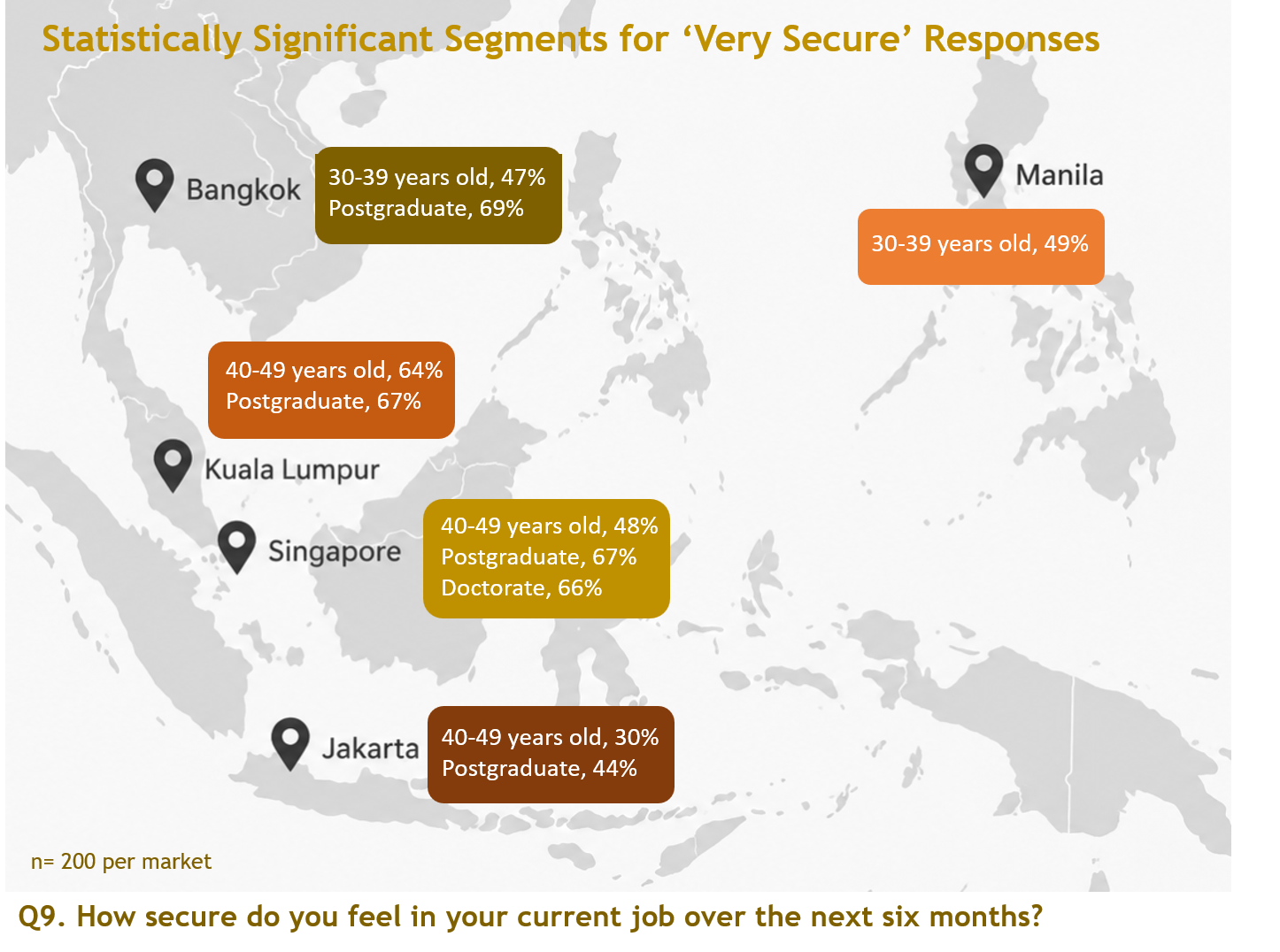
Across all five cities, individuals reporting the highest levels of job security over the next six months tended to be professionals in their prime working years and those with advanced educational qualifications.
In Singapore, two-thirds of postgraduate and doctorate respondents reported feeling very secure in their current roles. Similar patterns appeared in Kuala Lumpur and Bangkok, where postgraduate respondents also reported some of the strongest levels of employment confidence.
At first glance, this appears reassuring and conventional workforce thinking would suggest that secure workers are likely satisfied workers. The belief is that secure employees stay while insecure employees leave but careers rarely work so neatly.
Modern professionals increasingly derive confidence not from a single employer, but from their perceived employability. Someone may feel secure because they possess sought-after skills, specialised expertise or significant experience. The confidence may stem not from a belief that their current job will last forever, but from a belief that they could adapt if circumstances changed.
This raises an important question for the future of work - are people feeling secure because they trust their employer, or because they trust themselves? The distinction matters because one reflects organisational stability. The other reflects personal confidence.
The Curious Case of Workers Who Aren’t Looking
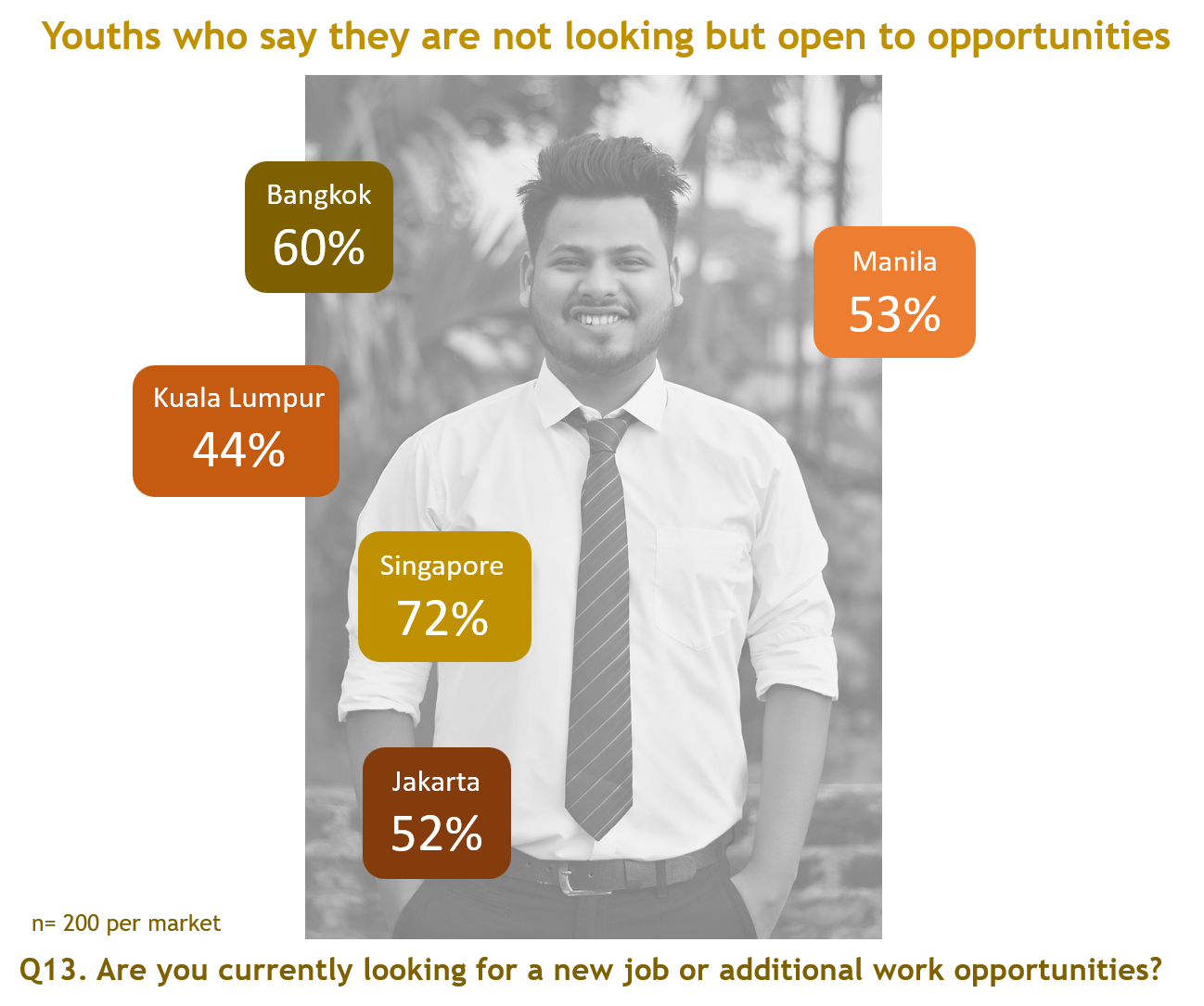
One of the most surprising findings emerged when respondents were asked whether they were currently looking for a new job. Across the five cities, many younger respondents aged 18-29 indicated that they were not actively job hunting but remained open to opportunities.
The pattern was particularly strong in Singapore, where 72% of respondents in this age group fell into this category. Similar patterns appeared in Bangkok, Manila, Jakarta and Kuala Lumpur.
Traditionally, workforce analysis divides people into categories; Looking for work versus not looking for work or satisfied versus unsatisfied. Yet this group fits none of those definitions comfortably.
These respondents are not urgently searching for new employment. Nor do they appear fully committed to staying where they are. Instead, they appear to be maintaining options.
This might be one of the defining characteristics of today's workforce. Career mobility no longer begins when someone resigns. It begins much earlier, with a mindset that remains receptive to possibilities. In many ways, this reflects a shift from job security to career security. A generation ago, security often meant staying. Today, security may mean knowing you can move if you choose.
When People Dream, They Dream Beyond Their Current Job
Perhaps the most revealing part of the study involved a simple question: What is your dream job or ideal career?
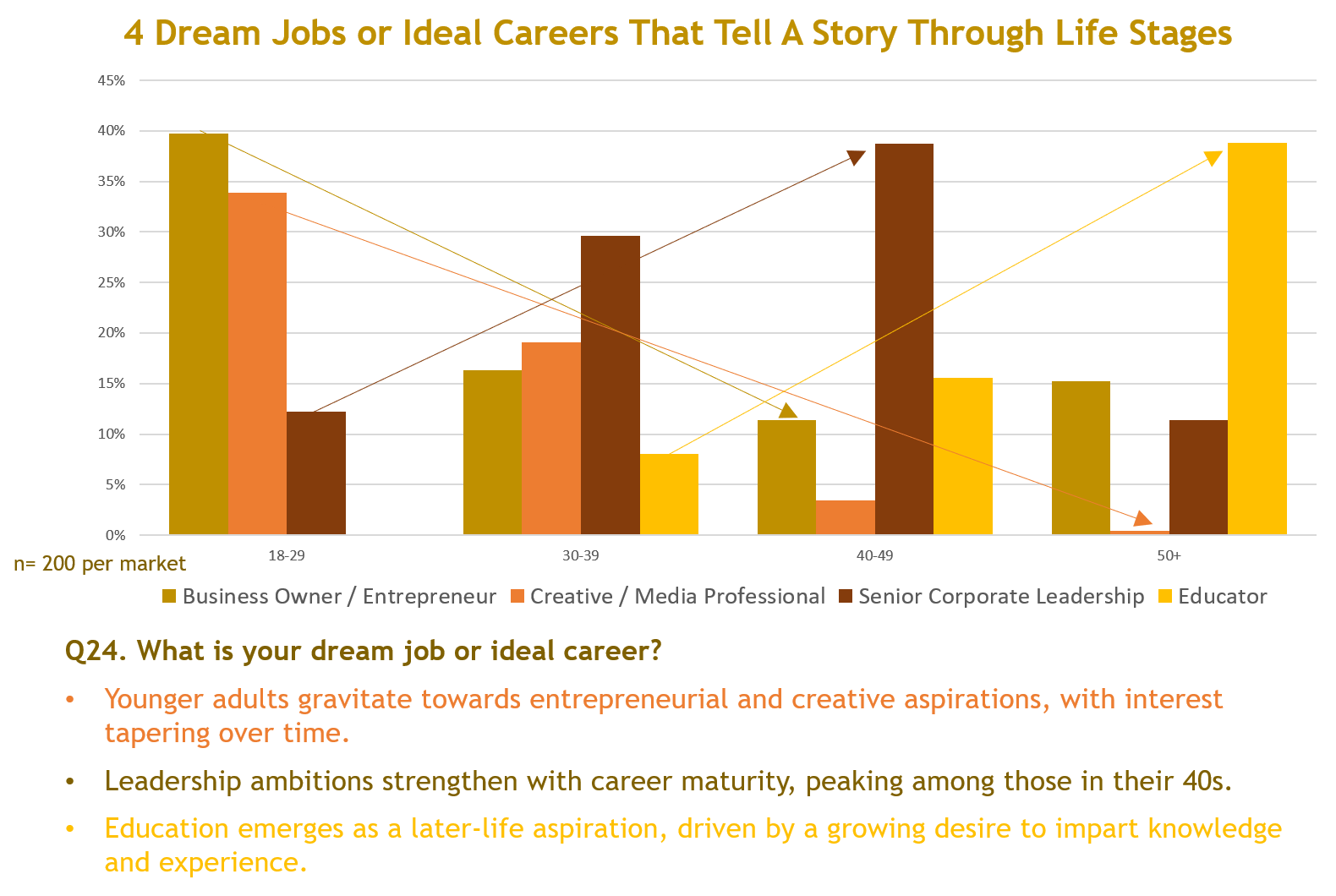
The answers tell a story about how ambition evolves over the course of a lifetime. Among respondents aged 18-29, entrepreneurship and creative professions dominated. Business Owner emerged as the leading aspiration in Singapore and Jakarta, while Creative Media Professional featured prominently in Kuala Lumpur, Manila and Bangkok. These are careers associated with autonomy, expression and independence. Young respondents did not appear to be dreaming of organisational hierarchy - they appeared to be dreaming of freedom.
By the time respondents reached their thirties, aspirations began to change. Senior Corporate Leadership emerged as a significant aspiration in Jakarta and Bangkok. Finance Professional appeared in Kuala Lumpur. Leadership, influence and professional achievement became more prominent.
The focus appeared to shift from creating something independently to leading something larger. Then another change occurred - among many respondents aged 40-49, Educator began appearing as a significant aspiration. The same trend continued among respondents aged 50 and above across several markets.
This finding is particularly intriguing because education is rarely associated with the highest-paying professions. If salary were the sole driver of career ambition, one might expect leadership positions to dominate all age groups. Instead, a different pattern emerges. We find younger respondents dream of creating while mid-career respondents dream of leading and older respondents increasingly dream of teaching. Career aspirations are not a fixed destination. It changes over time, maturity in the workforce and life experiences.
The Obstacle Changes as We Age
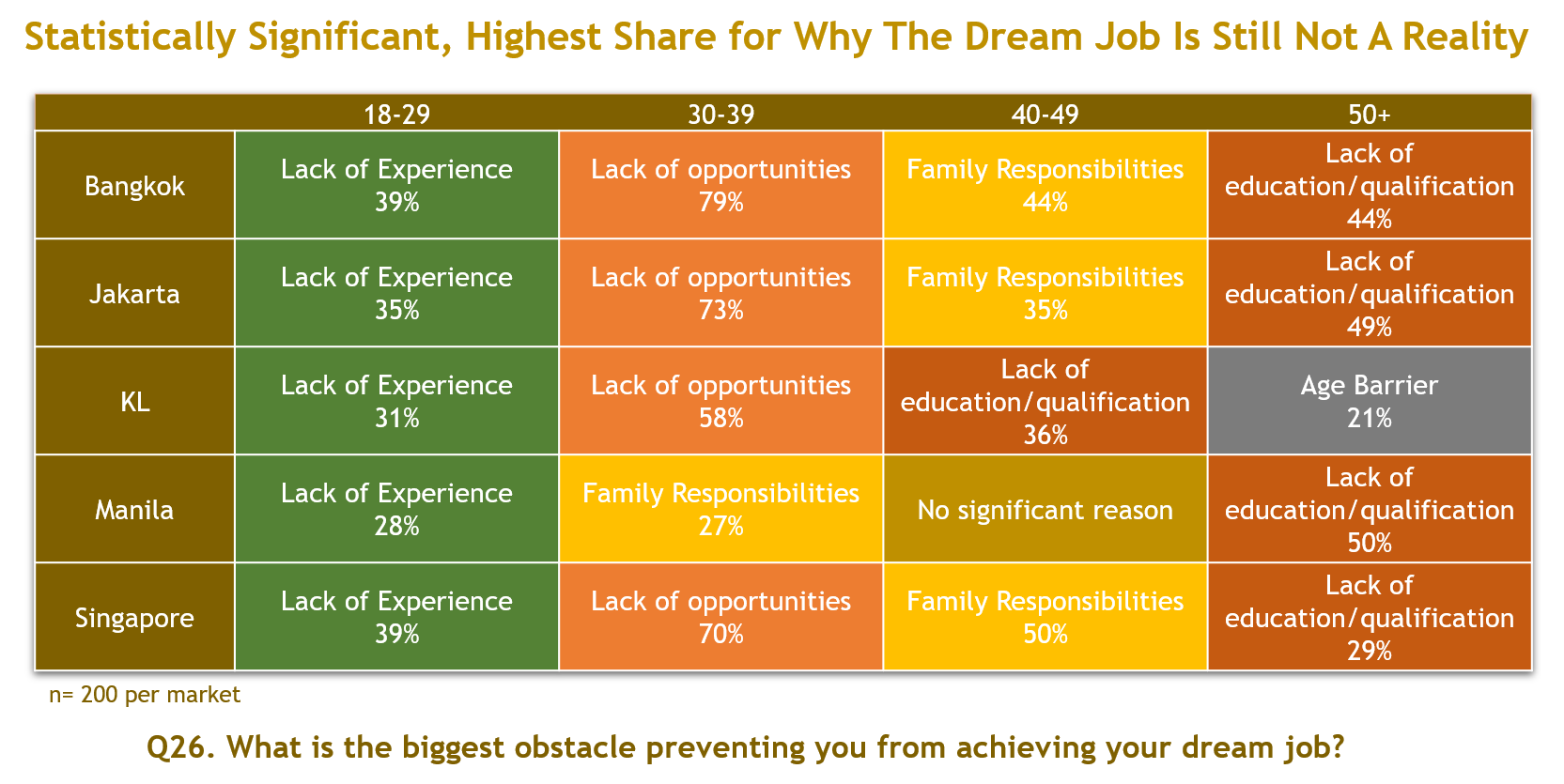
The dream job is only half the story. The other half lies in understanding what people believe is holding them back.
Among respondents aged 18-29, the most frequently cited obstacle was remarkably consistent across markets: Lack of experience. Singapore, Kuala Lumpur, Jakarta, Manila and Bangkok all showed similar patterns. This suggests that younger workers may not be suffering from a lack of ambition. Rather, many feel they have not yet accumulated sufficient credibility, skills or track record to pursue their ideal career. In other words, the barrier is personal.
The response changes dramatically among people aged 30-39. Across Singapore, Jakarta, Bangkok and Kuala Lumpur, the dominant obstacle became the lack of opportunities. The twenties appear to be characterised by self-development while the thirties appear to be characterised by opportunity constraints. The narrative shifts from: "I need more experience." to: "I need a chance.". Individuals in this stage of life may already possess the skills, qualifications and confidence they need. What they perceive as missing is access to the next step. This could be the promotion, the leadership role, the breakthrough opportunity or the move into a different industry.
By the forties, another factor begins to dominate - family responsibilities. Respondents in Singapore, Jakarta and Bangkok frequently identified family obligations as the primary obstacle standing between them and their dream career. This may partially explain why many respondents in this age group simultaneously report stronger job security as security becomes more valuable when responsibilities increase. Career decisions are no longer made in isolation but made within households. They are made with mortgages, school fees, ageing parents and broader family commitments in mind. The result is a more complex relationship with work.
A New Way of Thinking About Career Success
Taken together, the findings point toward a larger idea. The traditional career model assumes a relatively straightforward journey: Education leads to employment, employment leads to progression and progression leads to success. Yet the simulation suggests reality may be far more dynamic.
A secure professional may still dream of becoming an entrepreneur. A young worker may not be actively job hunting yet remain highly open to opportunity. An experienced executive may quietly aspire to become an educator. Someone approaching retirement may define success completely differently than they did twenty years earlier. These are not contradictions, they are evidence that careers evolve as people evolve. The future of work may not be about helping people find a perfect job, it may be about helping people navigate shifting definitions of success throughout their lives.
The Bigger Question
Most workforce discussions focus on employment rates, salary growth and labour market conditions. Those measures remain important but they do not tell the whole story. People do not wake up each morning thinking about employment statistics. They think about security, opportunity, purpose, family, identity, ambition and they seem willing to hold several of those goals simultaneously.
Perhaps that is the most interesting finding from this Data-Powered Simulation. The people who feel secure are not necessarily standing still. The people who are open to opportunities are not necessarily dissatisfied. And the dream career people imagine at 25 may bear little resemblance to the one they imagine at 55. The future of work may therefore be less about finding the right job and more about continually redefining what a successful career looks like.

About the Data-Powered Simulation Series
This series explores how data can be used to investigate unconventional questions across employment, parenting, aging, Gen Z, health and culture. These simulations are designed to challenge assumptions, stimulate discussion, and demonstrate how data can uncover unexpected stories.
Do you have a burning question, a curiosity about society, or a "what if" that you've always wondered about? We'd love to hear from you. Write to us at getintouch@dexterre.com and your question could inspire a future Data-Powered Simulation.