The Southeast Asian Hustle: What 5 Cities Reveal About Income Aspirations and Work-Life Tradeoffs

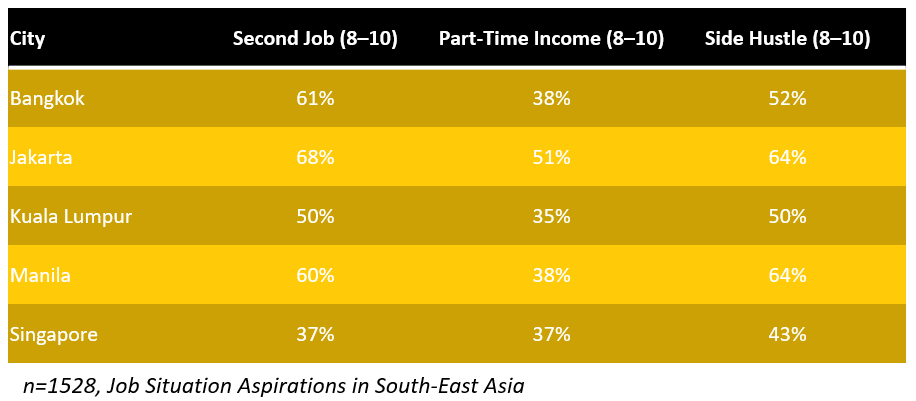
In Southeast Asia, the pursuit of income is no longer just about climbing the corporate ladder—it’s about flexibility, autonomy, and financial sufficiency. We asked residents from Bangkok, Jakarta, Kuala Lumpur, Manila, and Singapore to rate their agreement with three statements:
- “Ideally, I can find a second job to earn more income.”
- “Ideally, I can earn enough working part-time so that I don’t have to work full-time.”
- “Ideally, I can find a side income to earn more.”
Those who scored 8, 9, or 10 signal strong intent—whether it’s to supplement, restructure, or escape traditional work models. The results reveal a region negotiating the tension between security and sufficiency, effort and autonomy, ambition and exhaustion.
Income Aspirations Across Southeast Asia
Jakarta & Manila: The Hustle Capitals
Jakarta and Manila lead in both second job and side hustle aspirations. With 68% and 64% respectively seeking additional income streams, these cities reflect a workforce that’s resourceful, resilient, and restless.
This isn’t just about ambition—it’s about economic necessity. Rising living costs, inflation, and informal employment structures may be driving people to layer income sources while maintaining job security.
Strategic Insight: Brands and platforms that support multi-stream income models, freelance enablement, and financial literacy will resonate deeply here.
Bangkok: Security First, Hustle Second
In Bangkok, 61% prefer a second job, while 52% lean toward side hustles. But only 38% aspire to part-time sufficiency. This suggests a workforce that values job stability, but is willing to sacrifice time for financial goals.
The Bangkok mindset appears to be: “Keep the day job, but earn more on the side.”
Strategic Insight: Bangkok is primed for after-hours gig platforms, modular freelance opportunities, and low-friction income tools.
Kuala Lumpur: The Quiet Strivers*
KL shows moderate interest across all three statements, with 50% favoring both second jobs and side hustles, and only 35% preferring part-time sufficiency. This reflects a structured ambition—a desire to earn more, but within manageable boundaries.
Strategic Insight: KL’s workforce may respond best to credentialed side gigs, professional freelance networks, and career-aligned income supplements.
Singapore: The Strategic Minimalists*
Singapore shows the lowest scores across all three statements, with 37% preferring second jobs and part-time work, and 43% open to side hustles. This suggests a workforce that’s financially stable, but still open to strategic income optimization.
Here, side hustles may be less about survival and more about passion, investment, or intellectual stimulation.
Strategic Insight: Singapore’s aspirants may prefer high-skill freelance work, consulting gigs, or digital asset creation over time-for-money trades.
What the Data Tells Us
- Second jobs signal a willingness to trade time for money—often driven by financial pressure.
- Part-time aspirations reflect a desire to earn more with less effort—a critique of overwork.
Side hustles suggest a need for supplemental income, often tied to lifestyle upgrades or future planning.
Strategic Takeaways for Employers & Platforms
- Modular income ecosystems—from gig apps to creator platforms—will thrive in Jakarta, Manila, and Bangkok.
- Flexible work models must account for economic realities, not just lifestyle preferences.
- Financial empowerment tools—budgeting, investing, and passive income education—can help shift the narrative from hustle to sustainability.
Final Thought: The Hustle Is Human
Across Southeast Asia, the desire for more income isn’t just about money—it’s about agency, dignity, and possibility. Whether it’s a second job, a part-time dream, or a side hustle, the region’s workforce is telling us one thing loud and clear: “We’re ready to earn differently.”
If this piece resonates with the kind of data-backed, culturally attuned thought leadership your organization values, we’d love to connect. We specialize in transforming insight into impact—crafting modular strategies that speak to Southeast Asia’s evolving work cultures. Reach out to explore how we can support your next move.
Data Source: Asian Women Index 2024 Report, Dynata Panel
Graphics: Pixabay